
The strategic question comes before the tool
An AI strategist does not begin with “Which chatbot should we buy?” The stronger first question is: which result should improve, for whom, and what evidence would show that the change helped? This shift matters because a fluent draft can look impressive while creating extra checking, unsupported promises or no useful outcome.
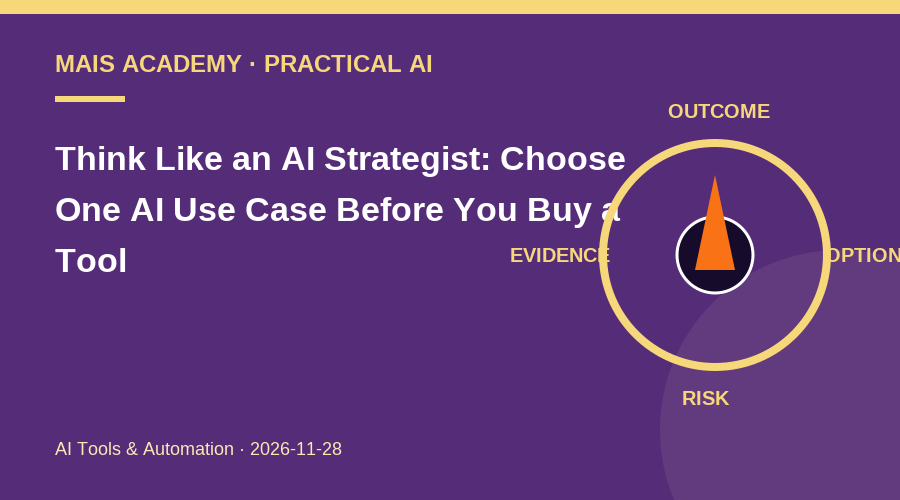
This article teaches SCORE: Situation, Clear outcome, Options, Risk and evidence, Experiment and decision. It is a practical decision method for ordinary office, career and small-business tasks. It is not a certification, and it does not guarantee accuracy, compliance, income or growth.
1. Map the current situation
Write the task as it happens today: trigger, input, owner, decision, output and handover. Include waiting time, correction time and the points where information goes missing. “We waste time” is vague; “the administrator spends about 35 minutes each morning sorting twelve enquiries” is testable.
Record the data involved and who may see it. Use fictional or anonymized practice data. Employment, financial, legal, safety, health and confidential work need stronger controls and qualified review.
2. Define the outcome without mentioning AI
“Use AI for enquiries” is a technology statement. A clearer outcome is: “Reduce morning sorting time while keeping every urgent enquiry visible and every customer promise under human review.” Add a baseline, a realistic test target, a quality floor and a measurement window.
Keep business outcomes separate from model quality. Style, fluency and speed are useful signals, but they do not prove that a customer received the right answer or that a team saved time after review.
3. Compare no-AI, assistive and automated options
Always include a no-AI option. A checklist, required form field or spreadsheet rule may solve the problem more cheaply and predictably. Compare it with an assistive option where AI drafts or classifies and a person decides. Treat higher-authority automation as a separate option with a higher evidence and approval burden.
A credible strategy allows “do not use AI yet” as a valid decision. Tool-neutral documentation also helps the team change providers later without losing the reasoning behind the workflow.
4. Worked example with transparent scoring
Fictional case: a small facilities company receives twelve morning enquiries. The team considers three options and scores each from one to five for value, data readiness and reversibility, then subtracts risk and review burden. The declared arithmetic is: queue summary 4 + 4 + 5 − 2 − 2 = 9; draft-only replies 5 + 4 + 5 − 3 − 3 = 8; automatic sending 5 + 3 + 1 − 5 − 5 = −1.
The queue summary ranks first under these stated judgments, so the team tests it privately in shadow mode. These numbers are not model-performance data or client results. Different assumptions may change the ranking, and a critical safety, privacy or legal gate can reject an option regardless of its score.
5. Build a checked evidence packet
For every important claim, record the source URL or approved file, the relevant page or range, the checked fact, the date checked, the owner and any limitation. Reuse the same checked evidence packet across the English article, Bangla article, ebook and video or social adaptation, then review translated meaning separately.
NIST’s AI Risk Management Framework organizes work around governing, mapping, measuring and managing AI risk. Google’s problem-framing guidance starts with the desired outcome and asks teams to compare machine-learning and non-ML approaches. Microsoft’s responsible-AI guidance stresses oversight, traceability and accountability. These principles support a small, reviewable first test.
6. Run a reversible experiment
Begin in shadow mode: AI produces a candidate result while the existing process remains authoritative. Prepare normal, missing-information, conflicting-source and pressure cases. Write the expected behavior before running them so the team cannot move the success standard after seeing the result.
Record elapsed time, corrections, unsupported claims, critical failures and reviewer effort. Keep external sending, purchasing, deletion and record-change permissions off during the first test. A named owner should be able to choose keep, repair, narrow or stop from the evidence.
7. Use the toolkit and seven-day plan
The practical guide includes an outcome card, workflow map, option matrix, risk-and-evidence sheet, test-case table, failure log and decision record. It also contains worked career, small-business and HR examples, three exercises with review criteria and a seven-day practice plan.
Day 1 maps one task and baseline; Day 2 writes the outcome card; Day 3 builds the evidence packet; Day 4 compares options; Day 5 prepares four test cases; Day 6 runs the private test; Day 7 records the keep, repair, narrow or stop decision. The next step is one low-risk task, one measured outcome and one reversible test.