


Recent Cloudburst News Highlights
1. Massive Flash Floods in Buner, Pakistan
- In mid-August 2025, the mountainous district of Buner in Pakistan was devastated by a rare cloudburst that unleashed over 150 mm of rain in just one hour. This triggered catastrophic flash floods, landslides, and destruction across villages.
- The death toll has soared—with estimates ranging from 207 to over 300 dead—making it one of the deadliest monsoon-related disasters in the region this year. Thousands have been displaced, and rescue operations are ongoing amid threats of more rain.Reuters+2Reuters+2AP NewsWikipediaAl Jazeera
2. Cloudburst and Flash Flood in Uttarakhand, India
- On August 5, 2025, a devastating flood struck Dharali village in Uttarkashi, Uttarakhand. Initially thought to be caused by a cloudburst, later assessments also consider the possibility of a glacial lake outburst flood (GLOF) or a landslide as contributing factors.WikipediaThe Times of India+1
- A joint aerial and ground survey by scientists confirmed that a cloudburst-induced moraine debris flow along the Kheer Gad stream likely triggered the flood.The Times of India
3. Cloudburst in Nanded, Maharashtra
- In western India, Nanded (Maharashtra) witnessed a severe cloudburst just days ago, resulting in eight fatalities and widespread disruption. The weather system brought Mumbai to a halt and significantly impacted crop and agricultural activities across the region.The Economic Times
4. Pilgrimage Tragedy in Chositi, Indian-Administered Kashmir
- A cloudburst struck Chositi village along the Machail Mata pilgrimage route on August 14, triggering flash floods that engulfed hundreds of people. Confirmed casualties stand at at least 67 dead, 300+ injured, and 200+ missing people.WikipediaPeople.com
- The floods destroyed key infrastructure such as the community kitchen and security post. Rescue efforts by national disaster response teams and the military are ongoing despite challenging terrain and weather conditions.People.comWikipedia
Summary Table
| Location | Date | Cause | Impacts |
| Buner, Pakistan | Mid-August 2025 | Cloudburst + Monsoon | ~207–300+ killed, villages destroyed, heavy displacement |
| Dharali, Uttarakhand | 5 August 2025 | Cloudburst / GLOF | 5+ dead, 50–100+ missing, debris flows, infrastructure loss |
| Nanded, Maharashtra | August 2025 | Cloudburst | 8 dead, major urban and rural disruption |
| Chositi, Kashmir | 14 August 2025 | Cloudburst | 67+ dead, 300+ injured, 200+ missing, pilgrimage halted |
Why This Matters
Cloudburst events—defined as very heavy rainfall (typically over 100 mm/hour) concentrated in small areas—are becoming increasingly frequent and destructive in regions like South Asia’s mountainous zones. The combination of monsoon systems, rising atmospheric moisture due to climate change, and vulnerable terrain poses growing risks. The Week Dawn
Countries like Pakistan and India are urgently grappling with how to improve early warning systems, bolster infrastructure resilience, and enhance disaster response capabilities in light of these intensifying threats.
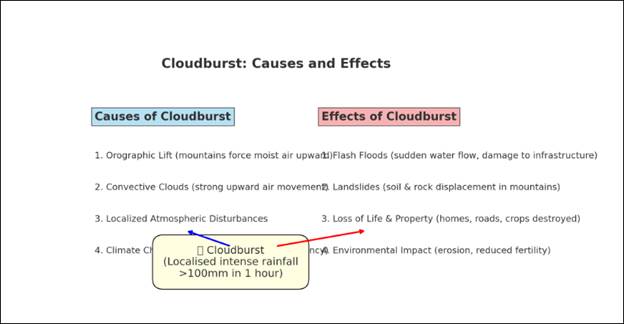
🌩️ What is a Cloudburst?
A cloudburst is an extreme amount of rainfall in a very short period of time, usually within minutes or a few hours, over a relatively small geographical area. It often leads to sudden flash floods and can cause massive destruction due to its intensity.
- Typically, rainfall greater than 100 mm (about 4 inches) within an hour over a small region is categorized as a cloudburst.
- Cloudbursts are different from normal heavy rains because they are localized, sudden, and highly intense.
⚡ Causes of Cloudburst
Cloudbursts occur mainly due to a combination of geographical, meteorological, and climatic conditions:
- Orographic Lift (Mountains & Hills)
- When monsoon winds carrying moist air hit mountain ranges, the air is forced upward rapidly.
- This cooling of moist air leads to sudden condensation and the release of huge amounts of water.
- Convective Clouds
- Strong convection (upward movement of warm, moist air) forms large cumulonimbus clouds.
- When these clouds cannot hold more water, they suddenly release moisture as a violent downpour.
- Localized Atmospheric Disturbances
- Temperature difference between surface air and upper atmosphere creates unstable conditions.
- If winds prevent clouds from spreading, all the rain falls in one concentrated area.
- Climate Change Factor
- Rising global temperatures increase moisture-holding capacity of the atmosphere.
- This leads to more frequent and intense short-duration rainfall events.
🌊 Effects of Cloudburst
Cloudbursts can have devastating impacts:
- Flash Floods
- Sudden flow of water overwhelms rivers, streams, and drainage systems.
- Causes destruction of homes, bridges, and roads.
- Landslides
- Mountain regions are highly vulnerable as heavy rains loosen soil and rocks.
- Loss of Life & Property
- Hundreds of deaths and thousands displaced in severe cases.
- Crops, livestock, and infrastructure suffer major losses.
- Long-term Environmental Impact
- Soil erosion, loss of agricultural productivity, and ecological imbalance.
🌍 Examples of Cloudbursts Around the World
1. India (Leh, Ladakh – 2010)
- A massive cloudburst in August 2010 caused over 200 mm of rain in just a few minutes.
- Flash floods and mudslides killed more than 200 people and destroyed homes, roads, and the airport.
2. Pakistan (Rawalpindi – 2001)
- Cloudburst caused 620 mm of rainfall in 10 hours.
- Led to urban flooding, killing 74 people and displacing thousands.
3. Nepal (Kaski District – 2012)
- Cloudburst-induced floods and landslides killed dozens.
- Several villages were swept away in mountainous terrain.
4. China (Beijing – 2012)
- Cloudburst-type event brought 170 mm of rain in 1 hour, leading to urban flooding.
- Over 70 people died and thousands were stranded.
5. United States (Colorado – 2013)
- Torrential rainfall in Boulder, Colorado caused flash floods.
- Though not officially called a cloudburst, it was a similar localized heavy rainfall event.
- Killed at least 8 people and damaged infrastructure worth billions of dollars.
6. United Arab Emirates (Dubai – 2019 & 2020)
- Sudden cloudbursts led to urban flooding in desert regions not prepared for heavy rainfall.
- Roads, malls, and airports were flooded, causing flight cancellations.
✅ Conclusion
A cloudburst is a sudden, intense rainfall event that causes destruction, especially in hilly and urban areas.
- Cause: Rapid condensation of moisture-laden clouds due to orographic lift, convection, and unstable atmospheric conditions.
- Effect: Flash floods, landslides, property destruction, and loss of life.
- Global Occurrence: Reported in countries like India, Pakistan, Nepal, China, USA, and even desert nations like UAE.
It highlights the need for early warning systems, better urban planning, and climate adaptation strategies to minimize damage.